


“In New Orleans, the most beautiful moments are often hidden—just beyond a gate, inside a quiet courtyard, where the city slows to a whisper.”

A STORIED ADDRESS
The History of 613 Royal Street

From Colonial Residence to Culinary Landmark
The property at 613 Royal Street has been part of New Orleans history since the early eighteenth century. By 1726 it served as the residence of Sieur Étienne de Périer, governor of colonial Louisiana and successor to Jean Baptiste Le Moyne de Bienville. The surrounding area, later known as Governor’s Row, became associated with political leadership and civic life during the formative years of the city.
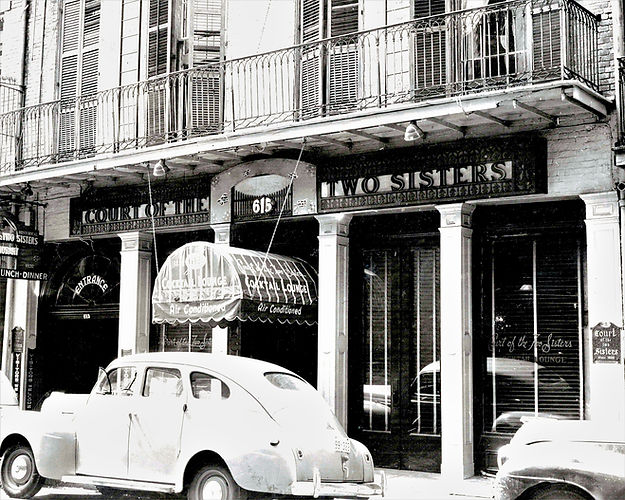
In 1832 a three story structure with an attic was constructed during a period of economic expansion. Built for Jean Baptiste Zenon Cavelier, president of the Bank of New Orleans and a veteran of the War of 1812, the building reflects the French townhouse style. Residential quarters occupied the upper floors while commercial activity took place at street level, establishing a pattern that would continue through the property’s later uses.

Transition, Revival & Preservation
During the late nineteenth century the property became the location of the Camors sisters’ notions shop. Their presence connected the site to the social and commercial life of the French Quarter, contributing to its reputation as a place of refinement and exchange. After the closure of the shop, the building passed through several owners and entered a period of changing use.
In the early and mid twentieth century the property functioned in a variety of roles, including a small restaurant and gathering place. A defining transition occurred in 1963 when Joe Fein Jr. acquired the building and began a program of preservation. His efforts focused on maintaining the architectural character of the property while establishing it as a dining institution within the city.

Legends, Courtyard & Modern Legacy
At the center of the property is its courtyard, one of the largest in the French Quarter. Originally designed to provide privacy and ventilation, it reflects the architectural traditions of New Orleans and the importance of outdoor space in urban life. The courtyard continues to serve as a place of gathering, framed by ironwork, brick, and plantings that echo the city’s historic character.
Today the Court of Two Sisters operates as both a historic landmark and an active restaurant shaped by generations of stewardship. Traditions of music, cuisine, and hospitality continue within a setting defined by its past. The property remains a place where visitors encounter not only a preserved structure, but an ongoing expression of New Orleans cultural life.


